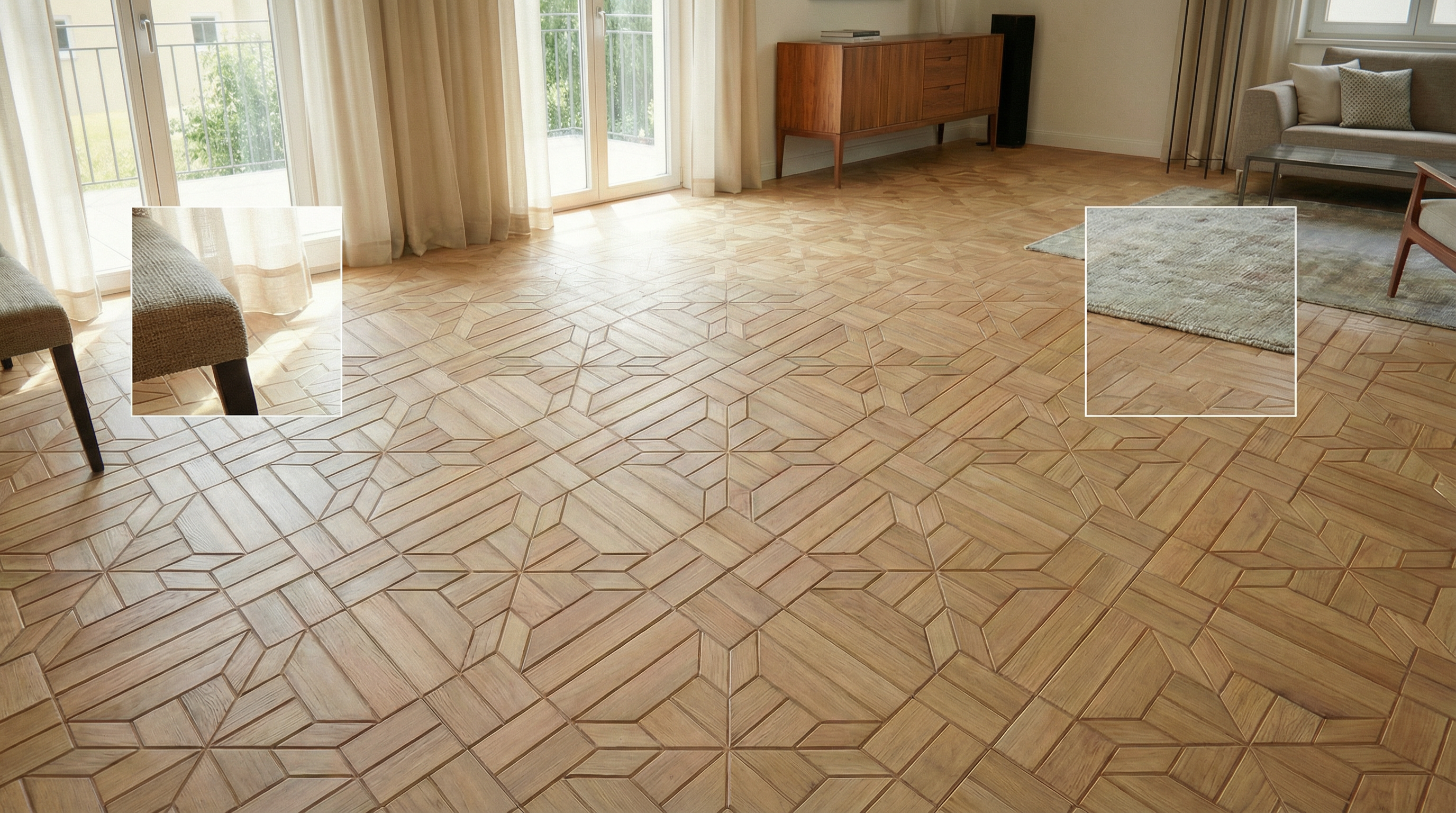
Parquet Pattern 45 Flooring - Diagonal Diamond Frame Design
Parquet Pattern 45 flooring features diagonal diamond frames creating dynamic geometric rhythm across floor surfaces. This distinguished parquet pattern uses contrasting wood species arranged at 45-degree angles to form interlocking diamond shapes that expand and contract visually, producing floors with sophisticated movement and architectural presence. The diagonal orientation creates energy and directional flow distinguishing Pattern 45 from rectilinear grid-based parquet designs.
Pattern Design Characteristics
The diagonal diamond geometry creates Pattern 45's signature visual dynamism. Unlike rectilinear patterns aligning with room walls, the 45-degree orientation establishes independent geometric logic creating visual tension between architectural boundaries and flooring pattern. This angular relationship energizes spaces, making Pattern 45 particularly effective in formal rooms requiring visual interest without overwhelming decorative elements competing for attention.
Frame-within-frame construction produces nested diamond shapes scaling from small central elements to larger perimeter frames. Each frame uses alternating wood species creating clearly defined boundaries between nested levels. This layered approach adds visual depth making two-dimensional floors appear more three-dimensional as perspective shifts when viewers move through spaces. The optical effect remains subtle yet sophisticated, rewarding careful observation without creating dizzying confusion.
The geometric precision required for Pattern 45 exceeds most parquet designs. Each piece must be cut to exact 45-degree angles with perfectly straight edges ensuring adjacent pieces meet without gaps or overlaps. Modern CNC cutting equipment achieves necessary tolerances, though historical installations relied on master craftspeople using hand planes, miter boxes, and shooting boards achieving remarkable precision through practiced skill and meticulous quality control.
Color contrast dramatically affects Pattern 45's visual impact. High-contrast combinations using light white oak with dark walnut create bold graphic effects emphasizing geometric complexity. Subtle contrasts pairing maple with cherry produce gentler designs reading as sophisticated texture rather than dramatic pattern statements. The contrast choice should align with overall interior design direction and architectural character.
Wood Species Selection for Pattern 45
White oak and walnut combinations provide traditional color contrast ensuring diamond frames remain visually distinct and clearly defined. The complementary hardness ratings of oak (Janka 1290) and walnut (Janka 1010) mean both species wear evenly maintaining sharp pattern definition through decades of service in high-traffic applications. This pairing represents time-tested reliability suitable for residential and commercial installations requiring demonstrated performance.
Maple and cherry pairings create warmer interpretations with less stark contrast. The creamy white tones of hard maple paired with cherry's reddish-brown heartwood produce Pattern 45 installations with gentler color gradations working well in traditional and transitional interior styles. As cherry ages naturally over 3-5 years, the contrast gradually increases allowing floors to evolve visually over time while maintaining aesthetic coherence and visual interest.
Hickory species deliver exceptional hardness (Janka 1820) suitable for commercial applications expecting heavy foot traffic. Hickory's natural color variation ranging from pale blonde sapwood to reddish-brown heartwood enables single-species Pattern 45 installations with inherent contrast. This approach simplifies manufacturing and installation while producing distinctive character impossible achieving with uniform-colored species requiring careful sorting and grading.
Exotic hardwoods including Brazilian cherry, teak, mahogany, and various tropical species enable custom color palettes distinct from domestic wood options. Brazilian cherry's deep red-orange tones paired with pale maple create dramatic warm-cool contrasts. Teak's golden-brown color with black grain patterns produces subtle elegance suitable for yacht interiors, high-end residential applications, and luxury commercial spaces. These materials command premium pricing but deliver distinctive appearances justifying investment in discerning markets.
Reclaimed materials from dismantled barns, decommissioned factories, and salvaged industrial buildings provide authentic patina and character new materials cannot replicate. The weathering and aging process creates color variations and surface textures adding depth to Pattern 45 geometry. Reclaimed wood supports sustainable building practices while producing one-of-a-kind floors with historical provenance and compelling storytelling value appreciated by environmentally conscious clients and historically sensitive projects.
Pattern Layout and Installation Planning
Successful Pattern 45 parquet installation requires meticulous planning addressing pattern alignment, module sizing, border treatments, and subfloor preparation. Professional installation expertise proves essential achieving the precision necessary for diamond frame integrity and long-term performance in demanding applications.
Layout planning begins with room measurement and pattern module sizing calculations ensuring pattern centers symmetrically avoiding narrow piece cuts at perimeter locations. The diagonal orientation complicates layout calculations compared to rectilinear patterns as room corners require triangular transition pieces rather than simple rectangular borders. Computer-aided design software helps visualize layout options and optimize module placement before cutting begins minimizing material waste.
Subfloor preparation demands exceptional flatness tolerances. Traditional parquet specifications require subfloor flatness within 1/8 inch over 10 feet, though diagonal patterns like Pattern 45 perform best with tighter tolerances of 1/16 inch over 10 feet. High spots cause individual pieces rocking under foot traffic creating annoying squeaks and accelerated adhesive bond failure. Low areas create voids compromising adhesive contact and structural integrity potentially leading to delamination.
Adhesive selection depends on wood species, subfloor material, and installation environment. Urethane-based adhesives provide excellent bond strength with moisture resistance suitable for concrete subfloors or installations over radiant heating systems. Traditional mastic adhesives work well over wood subfloors in climate-controlled environments. Trowel notch sizing controls adhesive application thickness ensuring adequate coverage without excessive squeeze-out between joints requiring difficult cleanup and potential staining.
Acclimation requirements match or exceed standard hardwood flooring protocols. Parquet pieces should acclimate to installation environment temperature and humidity for minimum 72 hours, though 5-7 days proves optimal for large-format installations. This allows wood moisture content equilibrating with ambient conditions minimizing post-installation movement causing gaps or buckling. Moisture meters verify proper acclimation before proceeding confirming wood moisture content matches environment within 2% tolerance.
Professional installers use laser levels establishing perfect diagonal reference lines guiding initial pattern placement. First sections receive maximum attention ensuring proper alignment and spacing establishing foundation for remaining installation. Pattern errors compound rapidly across large areas making initial precision critical to successful outcomes avoiding expensive tear-out and reinstallation. Experienced installers check alignment every few modules correcting minor deviations before they become visible problems compromising finished appearance.
Design Applications and Architectural Integration
Grand entrance foyers showcase Pattern 45's dynamic character, with diagonal diamonds creating immediate visual interest for arriving guests. The pattern's energetic geometry establishes sophisticated character appropriate for entry spaces while the diamond motifs add formal elegance absent from more casual flooring treatments. Larger module sizing scales appropriately to generous foyer proportions creating balanced visual presentation preventing pattern from appearing too busy or overwhelming architectural features.
Formal dining rooms benefit from Pattern 45's ability to anchor furniture arrangements while providing visual interest during meals when attention naturally drifts downward. The diagonal orientation creates visual boundaries helping define dining zones within open floor plans without requiring walls or other physical divisions. This makes Pattern 45 particularly effective in contemporary homes with flowing interior layouts where spatial definition comes from materials and finishes rather than enclosed rooms.
Executive office spaces leverage Pattern 45 establishing professional sophistication and attention to detail signaling organizational excellence and quality standards. The geometric precision references established business values and stability while the dynamic diagonal orientation suggests forward-thinking innovation and energy. Dark walnut and mahogany combinations create authoritative environments suitable for law firms, financial institutions, and executive suites expecting refined traditional character.
Boutique retail environments use Pattern 45 differentiating luxury brands from mass-market competitors. The distinctive flooring becomes memorable brand element customers associate with premium product quality and service standards. High-contrast patterns create Instagram-worthy visual backdrops encouraging social media sharing extending brand visibility beyond physical store locations generating organic marketing value far exceeding flooring investment costs.
Museum galleries and cultural institutions appreciate Pattern 45's historical associations with European palace architecture while the geometric order creates appropriate backgrounds for displayed artworks and artifacts. The pattern provides visual interest in empty galleries without competing with exhibits when spaces contain significant collections. Medium brown oak tones complement traditional architectural elements while remaining neutral enough supporting diverse curatorial programming and rotating exhibitions.
Custom Design Options and Multi-Species Combinations
Modern Pattern 45 installations offer extensive customization opportunities beyond traditional two-species natural finish approaches. Custom staining, multi-species combinations, and dimensional variations enable unique floors matching specific design visions and architectural requirements while maintaining pattern integrity and visual coherence.
Single-species installations with custom stain treatments allow precise color control coordinating floors with existing architectural elements or design schemes. Gray-stained oak creates contemporary aesthetic popular in modern residential and commercial projects. The stain maintains oak's grain patterns while shifting color palette toward current design trends. Honey and amber tones warm spaces while maintaining sophisticated restraint appropriate for traditional and transitional interiors avoiding excessive formality.
Multi-species combinations create graduated tonal effects impossible achieving through two-species installations. Light maple, medium oak, and dark walnut combinations enable complex designs with nuanced color transitions and enhanced visual depth. Three-species patterns require additional planning and precision during manufacturing and installation but produce extraordinary results justifying the increased complexity and investment in discerning residential and commercial applications.
Border treatments frame Pattern 45 field areas establishing visual boundaries and architectural definition preventing pattern from appearing to continue indefinitely beyond room boundaries. Simple running bond borders using same species as field create understated transitions. Contrasting species borders emphasize room geometry and architectural features drawing attention to proportion and spatial organization. Decorative inlay borders incorporating multiple species and geometric patterns transform floors into artistic statements worthy of museum-quality installations.
Pattern scale customization accommodates various room proportions and design preferences. Smaller modules measuring 18x18 inches create refined patterns suitable for intimate rooms or residential applications where subtle detail creates interest without overwhelming space. Larger 36x36 inch components deliver bolder geometry scaling appropriately to commercial spaces or grand residential rooms with generous proportions preventing pattern from appearing too busy or detailed for architectural context.
Module proportions can adjust maintaining diamond geometry while adapting to project-specific requirements. Elongated rectangles rather than perfect squares create directional emphasis guiding movement through circulation spaces. Custom sizing ensures pattern terminates cleanly at room perimeters avoiding awkward partial diamonds or excessive border widths appearing as afterthoughts rather than intentional design elements.
Finishing Options and Surface Protection
Oil-based polyurethane finishes represent traditional choices delivering warm amber tones enhancing natural wood colors. These finishes build substantial surface protection through multiple coat applications creating durable barriers resisting moisture penetration, stains, and abrasion. Three to four coats building 3-4 mil dry film thickness provide excellent protection for residential applications. Satin sheen levels prove most popular providing subtle luster highlighting wood grain without excessive gloss emphasizing every minor surface imperfection.
Water-based polyurethane alternatives maintain clearer color presentation without the amber cast characteristic of oil-based products. These finishes preserve contrasts in multi-species installations preventing the color homogenization sometimes occurring when amber-toned finishes blend light and dark species. Water-based products dry rapidly enabling faster project completion while producing lower VOC emissions important for occupied spaces or projects pursuing LEED certification and environmental credentials.
Natural oil finishes including tung oil, linseed oil, and hardwax oil products penetrate wood fibers rather than building surface films. These treatments enhance natural wood appearance creating matte surfaces with authentic character and tactile warmth. Oil finishes require more frequent maintenance than film-forming polyurethanes but enable easier spot repairs avoiding the complete refinishing often necessary when damaged polyurethane surfaces compromise visual uniformity across entire rooms.
Hardwax oil hybrid products combine penetrating oil benefits with surface wax protection delivering enhanced durability while maintaining natural appearance oil finishes provide. These systems prove popular for contemporary projects preferring matte surfaces and authentic wood character over high-gloss protection. Regular maintenance involves buffing with specialty pads renewing wax layer without sanding or heavy chemical stripping required for polyurethane refinishing extending service intervals.
Surface preparation before finish application determines final appearance quality. Professional installation includes thorough sanding progressing through multiple grits - typically 80, 120, and 150 grit - achieving perfectly smooth surfaces ready for finish acceptance. Final sanding removes any installation adhesive residue, levels minor height variations between adjacent pieces, and creates optimal surfaces ensuring proper finish adhesion and uniform appearance across entire floor area.
Maintenance Requirements and Long-Term Care
Proper maintenance preserves Pattern 45 parquet beauty and extends service life decades beyond typical flooring materials. Establishing appropriate care protocols from installation prevents damage requiring expensive restoration procedures and ensures floors maintain visual appeal throughout extended service lives in demanding residential and commercial applications.
Daily cleaning requires only dry dust mopping or vacuuming with floor brush attachments removing loose dirt and debris. Grit particles tracked onto floors from outdoor areas act as abrasives accelerating finish wear and potentially scratching wood surfaces beneath protective coatings. Regular removal prevents this damage while maintaining clean appearance essential for professional and residential environments where first impressions influence visitor perceptions.
Periodic damp cleaning using products specifically formulated for hardwood floors removes accumulated soils dust mopping misses. These cleaners avoid excessive moisture and harsh chemicals potentially damaging finishes or wood. Microfiber mops work effectively applying minimal moisture while lifting dirt from surface textures created by diamond pattern grain direction changes and joint interfaces. Cleaning frequency depends on traffic levels - weekly for residential areas, daily for commercial applications expecting heavy use.
Protective measures including entry mats, area rugs in high-traffic zones, and furniture pads prevent finish wear and surface damage. Quality entry mats trap dirt and moisture at doorways before reaching wood floors preventing abrasive damage and water exposure. Area rugs distribute traffic loads protecting high-wear pathways between frequently used areas. Felt pads under furniture legs prevent scratches and dents from moving chairs and tables during normal use.
Humidity control proves critical for parquet longevity. Maintaining 35-55% relative humidity prevents excessive seasonal movement causing gaps during dry winter months when heating systems remove moisture from interior air. Summer humidity requires dehumidification preventing swelling and cupping when moisture levels exceed wood equilibrium points. HVAC systems with humidity monitoring and control capabilities maintain stable conditions protecting floors and other wood elements throughout buildings.
Refinishing intervals depend on traffic levels and finish type. Residential installations typically require refinishing every 10-15 years depending on household size and activity levels. Commercial applications may need refinishing every 5-7 years in high-traffic zones. Oil-finished floors need recoating every 1-2 years but this maintenance can occur in occupied spaces without dust and disruption film finish sanding generates requiring space evacuation and extensive cleanup.
Historical Context and Contemporary Revival
Pattern 45 derives from centuries-old European flooring traditions flourishing during 17th and 18th century French and Italian estate construction. The pattern designation references the 45-degree angle defining its characteristic diagonal orientation, though similar geometric layouts appeared throughout European palace and manor installations under various regional names reflecting local design traditions and craftsmanship schools.
Historical parquet manufacturing involved intensive hand labor. Craftsmen cut individual pieces to precise dimensions using hand saws and templates, assembled them into modules using hide glues and mechanical fasteners, and installed these panels creating expansive patterned floors. This labor-intensive production limited parquet to wealthy patrons affording the substantial costs involved. Installation in prominent estates signaled wealth, taste, and cultural sophistication establishing social status through architectural patronage and conspicuous consumption.
French ébénistes (cabinetmakers) achieved international recognition for parquet artistry incorporating multiple wood species, intricate inlay borders, and elaborate geometric patterns. Their work established aesthetic standards influencing flooring design across Europe and eventually American Gilded Age estate architecture. Pattern books circulated among craftspeople codifying designs and establishing pattern nomenclature still referenced in contemporary parquet specification and sales literature.
The pattern experienced declining popularity during mid-20th century as wall-to-wall carpeting and simpler plank flooring dominated residential markets. Cost considerations, changing aesthetic preferences favoring casual rather than formal interiors, and limited craftspeople possessing traditional parquet skills contributed to this decline. Many historical installations suffered damage from neglect or inappropriate maintenance as building occupants lacked knowledge about proper care techniques for specialized flooring materials.
Contemporary revival began during 1990s as designers rediscovered parquet's sophisticated aesthetic and homeowners sought distinctive flooring alternatives to ubiquitous oak plank installations. Modern manufacturing technologies including CNC cutting equipment reduced production costs making parquet accessible to broader markets while maintaining quality standards matching or exceeding historical work. Computer-controlled precision enables tolerances impossible achieving with hand tools producing superior dimensional accuracy and pattern continuity.
Current installations benefit from advanced adhesives, precision cutting equipment, and sophisticated finishing systems unavailable to historical craftspeople. Urethane adhesives provide superior bond strength and moisture resistance compared to hide glues. Water-based polyurethanes deliver durability with environmental advantages. These improvements deliver superior performance and longevity while preserving authentic aesthetic character distinguishing traditional parquet patterns from modern interpretations and contemporary alternatives.
Comparing Pattern 45 to Other Diagonal Parquet Patterns
Understanding differences between various diagonal parquet patterns helps selecting appropriate designs for specific projects and aesthetic preferences. Each pattern offers distinct visual characteristics, installation considerations, and design associations influencing suitability for particular applications and architectural contexts.
Brittany parquet features nested diagonal square frames creating similar orientation to Pattern 45 but with different geometric vocabulary emphasizing squares rather than diamonds. Brittany patterns typically prove more formal with clearly defined frame hierarchies, while Pattern 45 creates more dynamic visual flow with interlocking diamond shapes suggesting continuous movement across floor surfaces.
Chevron parquet arranges pieces in continuous V-shaped patterns creating strong directional emphasis at similar 45-degree angles. Chevron patterns deliver more linear energy than Pattern 45's contained diamond geometry, guiding visual movement through spaces in specific directions. Chevron suits contemporary aesthetic preferences while Pattern 45 maintains traditional versatility working equally well in historical restoration and modern interpretations.
Herringbone parquet creates broken zigzag patterns visually similar to chevron but with staggered piece alignment producing different visual rhythm. Herringbone generally reads more casual than formal Pattern 45, working well in country house and farmhouse aesthetics where relaxed elegance trumps strict formality. The patterns can combine creating transitional zones between formal and casual areas.
Rhomb parquet creates three-dimensional tumbling blocks illusions using diamond-shaped pieces similar to Pattern 45 but arranged to suggest depth and perspective. Rhomb patterns prove more visually complex and potentially overwhelming in small spaces, while Pattern 45 maintains sophisticated character suitable for intimate rooms and grand spaces alike without creating dizzying optical effects.
Lana/Marseille patterns incorporate diagonal pinwheel elements creating rotational movement rather than Pattern 45's radiating expansion. The pinwheel geometry works well as medallion installations within Pattern 45 fields creating focal points and visual hierarchy impossible with single-pattern approaches. Combined installations produce sophisticated designs with visual variety maintaining cohesive aesthetic through shared diagonal vocabulary.
Investment Value and Pricing Considerations
Pattern 45 parquet represents significant flooring investment justified by exceptional longevity, timeless aesthetic appeal, and property value enhancement. Understanding complete project costs enables informed decision making and appropriate budget allocation for projects ranging from residential renovations to commercial installations expecting decades of reliable service.
Material costs vary substantially based on wood species selection, pattern complexity, and custom requirements. Domestic oak Pattern 45 parquet typically ranges $48-68 per square foot for quality materials including both light and dark species. Exotic species including walnut, cherry, or tropical hardwoods increase costs to $65-90 per square foot. Custom multi-species patterns or specialty finishes may exceed $90 per square foot for premium installations with exceptional materials and complex designs requiring master-level craftsmanship.
Professional installation costs range $32-55 per square foot depending on pattern complexity, room configuration, and regional labor rates. Pattern 45 requires more labor than simple plank installations due to precision requirements and diagonal orientation complicating edge treatments and corner transitions. Complex layouts with custom borders or medallion integrations increase installation costs to $50-65 per square foot reflecting additional planning and execution time.
Long-term value considerations favor parquet investment over less expensive flooring alternatives. Quality Pattern 45 installations routinely provide 50-75 years service life with periodic refinishing maintaining appearance and performance. This longevity delivers lower lifecycle costs than materials requiring replacement every 10-15 years - including carpet, luxury vinyl, and laminate products - despite higher initial investment. Refinishing every 10-15 years costs $4-8 per square foot significantly less than complete flooring replacement.
Property value enhancement represents another investment justification. Distinctive flooring becomes memorable feature differentiating properties in competitive real estate markets. Buyers recognize quality materials and craftsmanship reflected in asking prices and faster sales velocity. Pattern 45 parquet signals attention to detail and quality standards extending throughout properties creating positive halo effects influencing buyer perceptions of overall construction quality and maintenance standards.
Maintenance cost analysis should include annual cleaning supplies ($50-100), periodic professional cleaning ($200-400 annually for large areas), and refinishing expenses every 10-15 years ($4-8 per square foot). These costs remain modest compared to carpet replacement ($5-15 per square foot every 10 years) or other flooring renewal requirements. Well-maintained parquet appreciates value over time as material quality and craftsmanship become increasingly rare in new construction dominated by cost-reduction strategies.
Sustainable Sourcing and Environmental Considerations
Environmental consciousness increasingly influences flooring material selection as consumers and designers prioritize sustainable practices and responsible sourcing. Pattern 45 parquet offers several sustainability advantages over many flooring alternatives when sourced and specified appropriately with attention to certifications and supply chain transparency.
Wood represents renewable resource unlike petroleum-based flooring materials or stone requiring energy-intensive quarrying and processing. Responsibly managed forests regenerate providing continuous material supply without depleting finite resources. Forest Stewardship Council (FSC) certification verifies sustainable harvest practices ensuring forest ecosystems maintain biodiversity and productivity supporting wildlife habitat and ecosystem services including carbon sequestration and watershed protection.
Domestic hardwood species including oak, maple, hickory, and walnut grow throughout North American forests managed under strict sustainability regulations established by state forestry departments and federal agencies. These materials eliminate long-distance transportation carbon footprints while supporting domestic forestry employment and rural economies. Regional sourcing reduces environmental impact while providing excellent materials for Pattern 45 installations with quality matching or exceeding imported species.
Reclaimed wood flooring represents ultimate sustainable approach repurposing materials from demolished structures, dismantled barns, and decommissioned industrial buildings. Reclaimed oak, chestnut, and other species suitable for parquet manufacture deliver authentic character impossible replicating with new materials while preventing waste and avoiding new timber harvest. The embodied energy in reclaimed materials gets extended rather than discarded maximizing resource efficiency and environmental performance.
Exotic species require careful sourcing verification ensuring legal harvest and sustainable management. Many tropical nations lack forest management infrastructure enabling illegal logging decimating rainforests and threatening endangered species. CITES (Convention on International Trade in Endangered Species) regulations restrict trade in threatened species including certain rosewood, mahogany, and ebony varieties. Legitimate suppliers provide documentation verifying legal harvest and chain-of-custody tracking materials from forest to end user.
Low-VOC finishing systems minimize indoor air quality impacts during installation and long-term occupancy. Water-based polyurethanes, natural oil finishes, and hardwax oil products emit minimal volatile organic compounds compared to traditional solvent-based finishes. These products contribute to healthier indoor environments particularly important for residential applications and spaces occupied by children or individuals with chemical sensitivities.
Longevity represents perhaps parquet's greatest environmental advantage. Floors lasting 50-75 years avoid repeated manufacturing, transportation, installation, and disposal cycles associated with shorter-lived flooring materials. This durability dramatically reduces lifecycle environmental impact despite higher initial resource consumption and manufacturing energy requirements compared to simpler flooring products requiring more frequent replacement.
Visit Our Los Angeles Showroom
Experience the beauty and craftsmanship of Pattern 45 parquet firsthand at our Los Angeles showroom. We maintain samples of various parquet patterns in different wood species, allowing you to see actual materials and pattern configurations before making final design decisions.
Our design consultants provide personalized attention discussing project requirements, reviewing design options, and developing detailed proposals addressing all aspects of material selection, pattern customization, installation planning, and finishing specifications.
Contact Walter's Flooring today to schedule your consultation:
Phone: 213-792-5908
Email: info@legnohardwood.com
Address: 9216 S. Vermont Ave, Los Angeles, CA 90044
Showroom Hours:
Monday - Friday: 8:00 AM - 5:00 PM
Saturday & Sunday: By Appointment
Whether planning new construction projects, historic restorations, or residential renovations, Walter's Flooring delivers expertise, materials, and craftsmanship needed creating extraordinary Pattern 45 parquet installations defining luxury flooring at its finest.
Explore Expanded Options
Browse additional parquet patterns, wood species combinations, and custom geometric designs not shown on this page.
View Full Gallery →