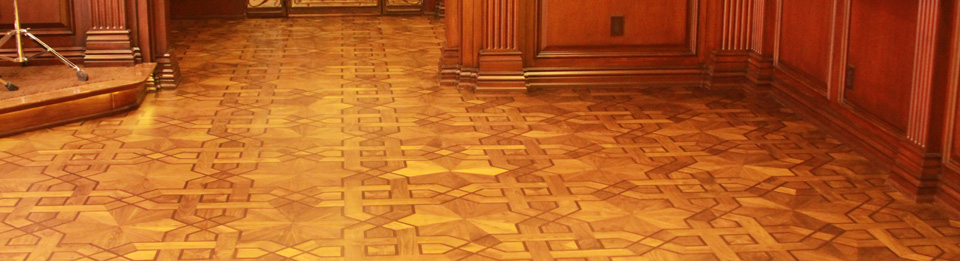
Stars Reclaimed Parquet Flooring - White Oak & Walnut Three-Star Pattern
Stars pattern parquet flooring recreates one of the most elegant and mathematically precise parquet designs from 19th century European craftsmanship—a radiating three-star geometric pattern combining white oak and select walnut woods in intricate interlocking formations that create mesmerizing visual depth and movement. This classic parquet configuration features three identical six-pointed stars arranged in repeating tessellated patterns where each star's radiating points interlock with adjacent stars creating seamless geometric flow across the entire floor surface. The Stars pattern demonstrates the delicate precision and intelligent assembly techniques that defined Victorian-era parquet artistry, where master craftsmen hand-selected wood pieces and arranged them with mathematical exactitude to achieve perfectly balanced symmetrical designs. Stars parquet brings authentic Old World charm, historical gravitas, and artisan sophistication to any interior space.
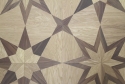
The Stars parquet pattern achieves its distinctive appearance through contrast—the combination of white oak's light honey-blonde coloring with walnut's rich chocolate-brown tones creates the visual definition that makes the three-star geometry legible and dramatic. Each star radiates from central hexagonal cores with six elongated diamond-shaped points extending outward. Where three stars meet, their interlocking points form perfect triangular negative spaces creating secondary geometric patterns within the primary star design. This complex layering of shapes-within-shapes generates visual interest that rewards close examination while maintaining coherent overall composition when viewed from a distance. The interplay of light and dark woods enhances dimensional perception—the contrasting colors make the pattern appear to have depth and relief even though the surface remains perfectly flat.
Understanding the Stars Pattern Geometry
The Stars parquet geometric design follows strict mathematical principles:
Six-Pointed Star Construction: Each star consists of a central hexagon surrounded by six elongated diamond points radiating at 60-degree intervals. The hexagonal center typically measures 3-4 inches across, with diamond points extending an additional 4-6 inches creating overall star diameters of 11-14 inches. Each diamond point comprises multiple wood strips (typically 3-5 strips per point) precision-cut to exact angles ensuring perfect geometric alignment when assembled.
Three-Star Module Repeat: Stars parquet tessellates through three-star groupings—three complete stars arranged in triangular formation with their outer points interlocking. This three-star module becomes the basic repeating unit that tiles across the floor in all directions. The repeat module typically measures 18-24 inches across allowing efficient production while creating visually complex overall patterns when multiple modules combine.
Interlocking Point Arrangement: The genius of Stars pattern lies in how adjacent stars interlock—each star's six points fit precisely between the points of surrounding stars creating perfect geometric continuity. At every junction where three stars meet, their interlocking points form equilateral triangles. These triangular interstices can be filled with contrasting wood (often the opposite wood from the star points—walnut triangles between oak stars, or vice versa) enhancing pattern legibility and visual rhythm.
Color Contrast Strategy: Traditional Stars parquet alternates wood species between primary stars and secondary elements. One configuration uses white oak for star centers and points with walnut for interlocking triangular spaces. Alternative arrangements reverse this—walnut stars on white oak background—creating dramatically different visual effects from identical geometry. Some high-end installations incorporate three or more wood species (oak, walnut, maple) creating even more complex color layering within the pattern.
Wood Species in Stars Parquet
White oak provides the light element in Stars parquet:
Color and Grain Characteristics: White oak displays light tan to honey-blonde heartwood with subtle grey undertones. The wood's relatively straight grain with medium texture reads as consistent neutral background allowing darker walnut elements to provide contrast. White oak's natural color variation—ranging from pale cream in sapwood to richer golden-brown in heartwood—adds subtle tonal variation within the oak portions of the pattern preventing monotony.
Durability and Hardness: With Janka hardness of 1360, white oak provides excellent wear resistance appropriate for high-traffic parquet installations. The wood's density and strength handle the precision cutting required for parquet angles while maintaining sharp edges and clean geometric forms over decades of use.
Finishing Behavior: White oak accepts stain evenly and showcases clear protective finishes beautifully. Natural oil or polyurethane finishes enhance oak's warm honey tones without obscuring grain patterns. The wood's stable character maintains geometric precision—expansion and contraction remain minimal reducing risk of gaps opening in the intricate pattern.
Select walnut contributes dark contrast:
Rich Chocolate-Brown Color: Select walnut features deep chocolate to purple-brown heartwood creating dramatic contrast against white oak's blonde tones. The color difference provides the visual definition essential for Stars pattern legibility—without strong light/dark contrast, the geometric complexity becomes muddy and difficult to perceive. Walnut's natural color deepens beautifully with age and light exposure enhancing contrast over time.
Fine Grain Texture: Walnut's straight, fine grain texture complements oak's coarser grain. The subtle textural variety between species adds tactile interest while maintaining unified appearance—both woods machine to similar smooth surfaces creating seamless transitions at species boundaries within the pattern.
Workability for Precision Angles: Walnut machines exceptionally cleanly allowing the precise angle cuts and tight joinery Stars pattern demands. The wood holds sharp edges without splintering even in the delicate pointed tips of star radiations. This workability was crucial in 19th century when Stars patterns were hand-cut with minimal machinery—walnut responded beautifully to careful hand planing and fitting.
Alternative Species Combinations: While white oak and walnut represent the classic Stars parquet pairing, other species combinations can create different aesthetics. Light maple with darker mahogany, pale ash with walnut, or even three-species combinations (oak centers, walnut points, maple interstices) offer design flexibility while maintaining the fundamental geometric structure.
Historical Context of Stars Pattern
Stars parquet emerged during the Victorian era (1837-1901) when parquet flooring reached artistic heights in European and American high-style interiors. The pattern represents 19th century fascinations with geometry, mathematics, and precision craftsmanship. Victorian designers drew inspiration from Islamic geometric tile patterns, Gothic architectural ornament, and scientific illustrations of crystalline structures—all featuring radiating symmetrical forms similar to Stars parquet's repeating stellar shapes.
The technical achievement of Stars parquet impressed Victorian audiences. Creating the pattern required advanced woodworking skills: precise angle cutting (all angles in 60-degree multiples), perfect species matching (ensuring uniform color within each wood type), tight joinery (gaps would destroy geometric illusion), and mathematical layout planning (ensuring pattern alignment across large floor areas). Stars parquet in a Victorian mansion demonstrated the homeowner's wealth (affording expensive custom flooring), sophistication (appreciating complex geometric design), and access to skilled craftsmen (capable of executing the pattern correctly).
American parquet manufacturers in the late 1800s produced pre-fabricated Stars pattern tiles, typically 18x18 inch or 24x24 inch squares containing complete three-star modules ready for installation. These factory-made tiles democratized Stars pattern somewhat—middle-class homeowners could afford manufactured parquet tiles where fully custom field-assembled patterns remained exclusive to luxury homes. However, even pre-fabricated tiles required skilled installation ensuring pattern alignment between adjacent tiles.
Design Applications for Stars Parquet
Where Stars pattern excels:
Formal Entry Foyers: The traditional application—Stars parquet in entry halls creates immediate impact communicating elegance and craftsmanship upon arrival. The pattern's radiating geometry naturally draws the eye inward guiding visitors' attention through the space. A Stars pattern foyer establishes sophisticated tone for the entire home positioning it as a thoughtfully designed residence where details matter.
Library and Study Floors: Victorian libraries frequently featured geometric parquet including Stars patterns. The intellectual associations of mathematical precision and scholarly complexity align with libraries' purpose. Stars parquet under Persian rugs in a traditional study creates layered richness—pattern upon pattern—without competing visually since rugs cover most of the floor showing only borders. When rugs are removed for cleaning, the full Stars pattern is revealed providing seasonal variety.
Formal Dining Rooms: Stars parquet defines dining spaces with appropriate formality. The geometric pattern complements formal dining furniture—traditional mahogany tables and upholstered chairs gain visual foundation from elaborate floor patterns. In open-plan homes, Stars parquet installation limited to the dining zone provides spatial definition without physical walls or ceiling changes.
Master Suite Sitting Areas: Luxury master bedrooms often include sitting areas or reading nooks—Stars parquet defining these zones adds refinement while visually separating sleeping and sitting functions within the larger room. The pattern works particularly well in master suites with bay windows or distinctive architectural features where floor pattern reinforces architectural emphasis.
Boutique Commercial Interiors: High-end retail boutiques, law office reception areas, upscale restaurant entries, and luxury hotel lobbies use Stars parquet to communicate quality and attention to detail. In commercial settings, the pattern's complexity and obvious expense signal premium service and exclusive clientele. Stars parquet performs well under commercial traffic—the multi-directional wood grain orientation distributes wear more evenly than parallel strip flooring.
Gallery and Exhibition Spaces: Art galleries occasionally use decorative parquet as intentional backdrop for exhibitions. Stars pattern's geometric abstraction complements contemporary art without competing for attention. The historical provenance of Victorian parquet patterns can provide interesting conceptual dialogue with modern artworks creating tension between historical craft and contemporary expression.
Installation Methods and Considerations
Stars parquet installation presents significant challenges:
Pre-Fabricated Tile Panels: Modern Stars parquet typically comes as pre-assembled panels (usually 18x18 inch or 24x24 inch squares) containing complete three-star modules. These panels install similarly to large-format tile—adhered to flat subfloors using wood flooring adhesive. Panel installation dramatically reduces on-site labor compared to piece-by-piece field assembly while ensuring geometric accuracy since pattern assembly happens in controlled shop conditions.
Subfloor Flatness Requirements: Stars parquet demands exceptionally flat subfloors—the intricate geometry amplifies even slight level variations. Subfloors must be flat within 1/8 inch over 10 feet (stricter than standard hardwood's 3/16 inch tolerance). High spots cause panels to rock preventing full adhesive contact; low spots create unsupported areas vulnerable to cracking. Concrete subfloors work ideally for Stars parquet providing the required flatness and rigidity.
Pattern Orientation and Layout: Installers must carefully plan pattern orientation relative to room geometry. Stars pattern has inherent directionality despite geometric repetition—the hexagonal stars create subtle linear alignments at 60-degree angles. These alignments should ideally parallel key architectural features (fireplace centerlines, bay window axes) rather than running arbitrarily. Proper layout requires dry-fitting panels before adhesive application determining optimal pattern centering and orientation.
Edge Borders and Transitions: Stars pattern doesn't easily terminate at room edges since the three-star modules create irregular perimeters. Most installations require border strips—solid wood strips 3-6 inches wide in oak, walnut, or contrasting species—framing the Stars field and providing clean transitions to walls. These borders must be precision-cut to accommodate the pattern's hexagonal geometry preventing awkward partial stars at room edges.
Expansion Gaps and Movement: Despite Stars pattern's multi-directional grain orientation (reducing expansion tendency compared to parallel strip floors), expansion gaps remain necessary at all perimeters. Typical 1/2-inch gaps allow seasonal wood movement without buckling. In large rooms (over 20 feet any direction), mid-room expansion joints may be required—these can be integrated into the pattern as contrasting walnut or metal strips enhancing rather than detracting from the design.
Professional Installation Requirement: Stars parquet is decidedly not DIY-appropriate. Installation requires experience with geometric pattern flooring, understanding of wood movement principles, precision cutting for borders and transitions, and careful adhesive application. Expect installation costs of $18-35/sq ft (labor only) for Stars parquet compared to $8-15/sq ft for standard strip hardwood. The premium reflects specialized skills and time-intensive layout planning.
Finishing and Long-Term Maintenance
Finishing Stars parquet: After installation, the entire floor is sanded flat ensuring perfect level transitions between panels and species. Sanding must be gentle in final grits—aggressive sanding can create subtle depressions in softer white oak while harder walnut remains higher disrupting the geometric flatness. Professional finishers sand in multiple directions (diagonal, perpendicular, parallel to panel alignments) ensuring even material removal across all grain orientations.
Finish choice significantly affects appearance. Oil-based polyurethane amber-tones both species but enhances walnut more than oak reducing contrast slightly while creating warm unified glow. Water-based polyurethane maintains original color contrast keeping oak lighter and walnut darker for maximum geometric definition. Some designers prefer oil-rubbed or wax finishes for historical authenticity—Victorian Stars parquet originally received paste wax over shellac sealer creating soft matte luster different from modern high-gloss polyurethane.
Maintenance considerations: Stars parquet requires regular sweeping or vacuuming removing abrasive grit that could scratch the detailed surface. The pattern's complexity means scratches and wear show differently than on plain strip floors—damage that might blend into uniform oak planks becomes more visible when it disrupts geometric patterns. However, the multi-directional grain arrangement distributes wear more evenly preventing the concentrated traffic paths common in plank floors.
Refinishing potential depends on wear layer thickness. Pre-fabricated parquet panels typically have 2-4mm wear layers allowing 1-2 refinishing cycles over 40-60 years. Solid wood field-assembled Stars parquet (less common but still produced for ultra-luxury projects) has full 3/4-inch thickness permitting 4-5 refinishing cycles over 100+ year lifespan. During refinishing, the intricate pattern makes staining challenging—any stain application must maintain species color contrast preventing the pattern from becoming muddy.
Pricing and Value Proposition
Stars parquet represents significant investment:
Material Costs: Pre-fabricated Stars parquet panels cost $35-65/sq ft depending on wood quality (select grade costs more than common grade), panel size (larger 24x24 panels cost less per square foot than smaller tiles), and manufacturer reputation. Custom field-assembled Stars parquet using premium reclaimed oak and walnut can exceed $80-120/sq ft in materials alone due to labor-intensive piece-by-piece assembly.
Total Installed Costs: Including materials, professional installation, finishing, and border work, expect $55-100/sq ft for complete Stars parquet floors. A 200 sq ft entry foyer in Stars pattern typically costs $11,000-20,000 total. These prices position Stars parquet as luxury flooring comparable to high-end stone or custom tile work rather than standard hardwood.
Value Considerations: Despite high costs, Stars parquet provides lasting value through: permanent artistic flooring becoming signature home feature, authentic historical materials and patterns impossible to replicate cheaply, exceptional durability with multiple refinishing potential over century-plus lifespan, and distinctive character differentiating luxury homes in competitive markets. In heritage restoration projects or high-end new construction targeting discerning buyers, Stars parquet justifies premium pricing.
Comparing Stars to Other Parquet Patterns
Stars vs. Herringbone/Chevron: Herringbone and chevron use parallel wood strips arranged in V-patterns—simpler, more affordable, and easier to install than Stars. These patterns cost 40-60% less than Stars while still providing decorative appeal. Choose Stars for maximum visual impact and historical authenticity; choose herringbone for traditional elegance at moderate cost.
Stars vs. Versailles/Bordeaux Patterns: These classic French parquet patterns feature ornate geometric designs rivaling Stars in complexity. Versailles typically uses single wood species with grain direction creating pattern; Stars uses species contrast. Both represent similar luxury positioning and cost ranges. Pattern choice becomes aesthetic preference—Stars suits Victorian or American traditional styles, Versailles aligns with French-influenced classical interiors.
Stars vs. Custom Medallion Inlay: Custom floor medallions featuring scrollwork, floral motifs, or family crests can exceed Stars in cost and visual impact but cover smaller areas (typically 3-5 foot diameter centerpieces). Stars pattern can cover entire room floors where medallions work as focal points within simpler field floors. Combining a custom medallion with Stars pattern borders creates ultimate luxury flooring.
Modern Interpretations and Customization
Contemporary designers adapt Stars pattern through:
Scaled Variations: Enlarging the traditional pattern 150-200% creates more dramatic visual impact in larger modern rooms with higher ceilings. Oversized Stars (24-30 inch diameter individual stars) make bold statements in contemporary spaces while maintaining historical pattern geometry.
Alternative Material Combinations: Some modern Stars installations incorporate non-traditional materials—metal inlay strips defining star outlines, colored epoxy filling triangular interstices, or mixed materials combining wood stars with stone or tile backgrounds. These contemporary interpretations maintain geometric structure while updating material palette for modern aesthetics.
Monochromatic Variations: Using single wood species in varying surface treatments (smooth vs. wirebrush, natural vs. grey-stained) creates subtle Stars patterns visible through texture and sheen variation rather than color contrast. This minimalist approach suits contemporary interiors wanting pattern interest without Victorian ornament associations.
Request Samples and Consultation
Given Stars parquet's complexity and investment level, in-person consultation is strongly recommended. Visit our showroom to examine Stars pattern samples, compare wood species combinations, discuss sizing and customization options, and review installation details with experienced specialists.
Request samples showing white oak and walnut combinations, or request a detailed project quote providing room dimensions, preferred pattern scale, and installation timeline.
Call 213-792-5908 to schedule a Stars parquet consultation. Our team will help determine whether pre-fabricated panels or custom field assembly best suits your project's budget, timeline, and design vision.
Visit Our Showroom
See Stars parquet samples and wood species options at our showroom: 9216 S. Vermont Ave, Los Angeles, CA 90044
Showroom Hours:
Monday - Friday: 8:00 AM - 5:00 PM
Saturday & Sunday: By Appointment
Call 213-792-5908 to schedule your Stars parquet flooring consultation.
Explore Expanded Options
Browse additional parquet patterns, wood species combinations, and custom geometric designs not shown on this page.
View Full Gallery →