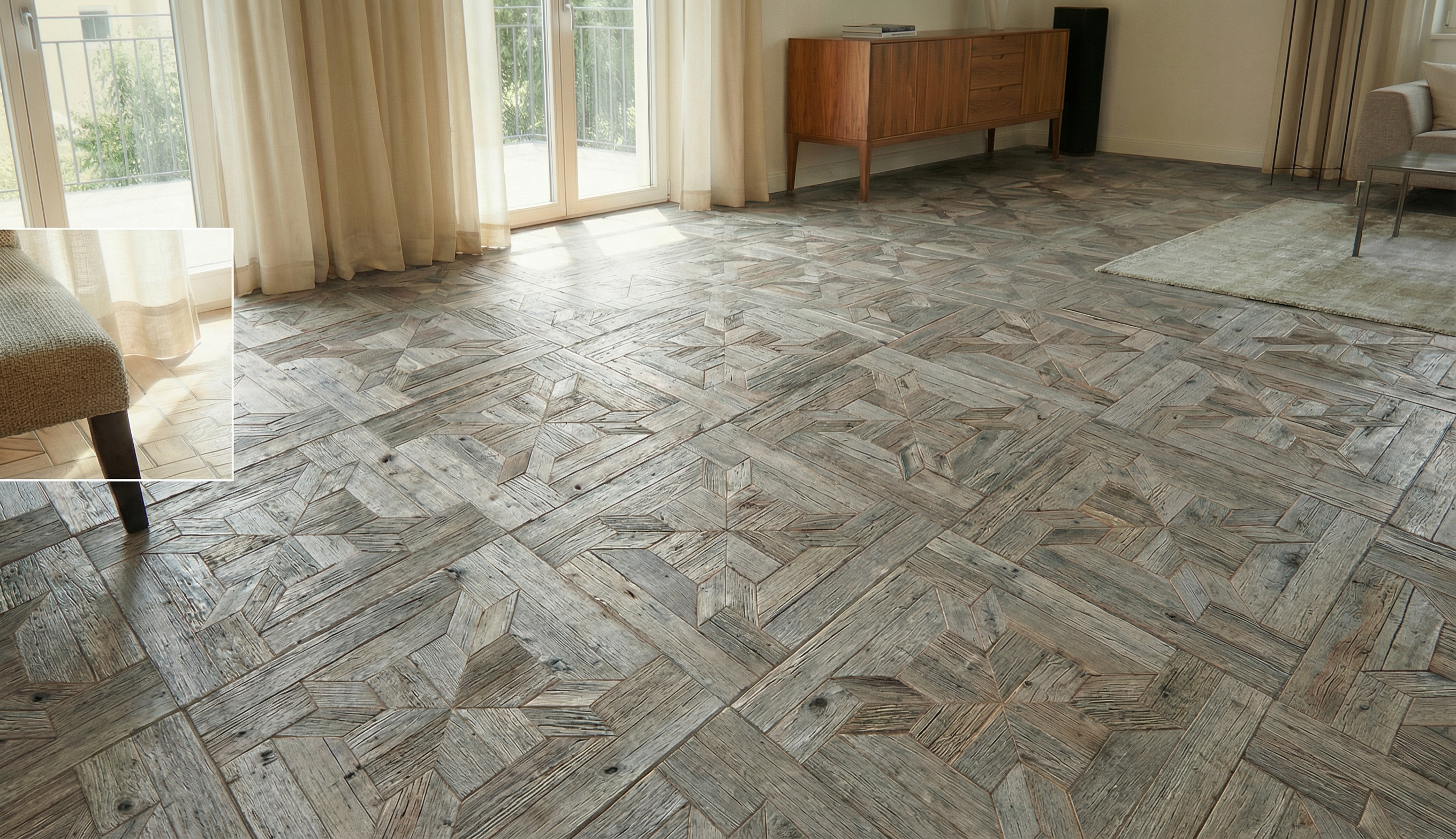
Parquet Pattern 2 Flooring - Intricate Geometric Design
Parquet Pattern 2 flooring showcases intricate interlocking geometric shapes that create sophisticated visual rhythm across floor surfaces. This complex parquet pattern combines angular elements with curved transitions forming distinctive motifs that repeat seamlessly throughout installations. Originally crafted for European aristocratic estates during the 18th century, Pattern 2 represents the height of parquet artistry where mathematical precision meets artistic expression creating floors suitable for the most discerning architectural projects.
Pattern Design Characteristics
The geometric complexity distinguishes Pattern 2 from simpler parquet designs. Multiple element types combine within each repeating module - angular triangles, curved arcs, diamond shapes, and rectangular frames - creating sophisticated visual interest that reveals new details at different viewing distances and lighting conditions. This complexity rewards extended observation making Pattern 2 particularly suitable for spaces where occupants spend significant time appreciating architectural details.
Scale flexibility allows Pattern 2 adaptation to various room proportions and design contexts. Standard modules measure 30x30 inches providing balanced rhythm for residential applications, while larger 36x36 inch or 42x42 inch modules scale appropriately to grand commercial lobbies and ceremonial halls. Smaller 24x24 inch modules create refined patterns suitable for intimate spaces where larger elements would overwhelm architectural proportions.
The pattern's directional ambiguity creates visual interest without imposing specific viewing orientations. Unlike chevron or herringbone patterns establishing clear directional flow, Pattern 2's balanced geometry reads equally well from any approach direction making it ideal for rooms with multiple entry points or open floor plans where traffic flows from various directions. This omnidirectional quality contributes to Pattern 2's sophisticated character and architectural versatility.
Color distribution strategies dramatically affect Pattern 2's appearance and spatial impact. High-contrast species pairings emphasize geometric complexity creating bold graphic statements. Subtle gradations using three or four wood species in graduated tones produce nuanced effects reading as elegant texture rather than assertive pattern. The multi-element design provides numerous opportunities for creative color placement impossible with simpler single-motif patterns.
Wood Species Selection for Pattern 2 Parquet
White oak and walnut combinations provide classic contrast suitable for Pattern 2's intricate geometry. The moderate hardness difference between oak (Janka 1290) and walnut (Janka 1010) ensures both species wear evenly maintaining pattern clarity over decades. White oak's creamy tones paired with walnut's rich chocolate browns create timeless contrast working across traditional, transitional, and contemporary design styles.
Maple, cherry, and mahogany tri-color combinations enable graduated tonal effects within Pattern 2's complex geometry. Pale maple establishes light elements, medium cherry provides transition tones, while deep mahogany creates dark accents. This three-species approach produces sophisticated depth impossible with simple light-dark contrasts. As cherry darkens naturally over several years, the tonal relationships evolve creating living floors that mature alongside building interiors.
Hickory's exceptional hardness (Janka 1820) suits Pattern 2 installations in demanding commercial applications including hotel lobbies, retail showrooms, and corporate headquarters expecting heavy foot traffic. Hickory's dramatic color variation from pale sapwood to dark heartwood enables single-species Pattern 2 installations with inherent contrast eliminating multi-species complexity while maintaining visual interest through natural wood characteristics.
Exotic species including Brazilian cherry, teak, wenge, and purpleheart create distinctive Pattern 2 installations with colors and figure impossible achieving through domestic species. Brazilian cherry's orange-red tones bring warmth to contemporary spaces. Teak's golden-brown stability suits yacht cabins and coastal installations. Wenge's nearly black color provides dramatic contrast paired with light species. Purpleheart's violet tones create memorable floors distinguishing luxury residential and boutique commercial projects.
Reclaimed walnut and oak from dismantled structures provide authentic patina and historical character new materials lack. Reclaimed wood's weathering creates color variations, nail holes, saw marks, and surface checking adding narrative depth to Pattern 2 geometry. Sustainability benefits include avoided new timber harvest and waste reduction while producing one-of-a-kind floors with stories connecting past architectural heritage to contemporary design.
Pattern Layout and Installation Planning
Pattern 2's complexity demands exceptional installation planning addressing geometric alignment, module orientation, border integration, and meticulous subfloor preparation. Professional expertise proves essential achieving the precision Pattern 2 requires for visual impact and long-term performance.
Computer-aided design enables visualization and optimization before installation begins. CAD software models Pattern 2 in actual room dimensions allowing designers and clients evaluating module placement, color distribution, and border treatments before committing to material cutting. This planning identifies potential issues including pattern interruptions at architectural features, module sizing adjustments for room proportions, and transition details where Pattern 2 meets other flooring materials.
Subfloor flatness requirements exceed standard hardwood specifications due to Pattern 2's numerous small pieces and complex geometry. Industry best practices specify flatness within 1/16 inch over 10 feet ensuring individual pieces remain fully supported by adhesive without rocking or telegraphing subfloor irregularities. Concrete subfloors require grinding high spots and filling low areas with self-leveling compound. Wood subfloors need sanding, planing, or shimming achieving required tolerances.
Adhesive selection considers wood species characteristics, subfloor material, and installation environment conditions. Urethane adhesives provide superior bond strength, moisture resistance, and gap-filling properties suitable for concrete subfloors and installations over radiant heating. Moisture-cured urethanes excel in applications where concrete moisture levels exceed ideal ranges. Traditional wood flooring mastics work well over wood subfloors in climate-controlled interior spaces with stable humidity.
Installation sequencing begins from room center establishing foundation modules with perfect alignment before expanding outward. Laser levels project reference lines ensuring each module placement maintains pattern integrity. Experienced installers verify alignment every few modules making micro-adjustments preventing cumulative errors that compound across large installations. The complex geometry amplifies minor errors making initial precision critical to successful outcomes.
Border treatments require special attention ensuring Pattern 2 field transitions gracefully to room perimeters. Simple borders using running bond patterns in single species create clean transitions. Decorative borders incorporating contrasting woods and geometric inlay elements frame Pattern 2 fields establishing visual hierarchy. Custom border designs can incorporate client monograms, company logos, or architectural motifs creating personalized floors with unique character.
Design Applications and Architectural Integration
Grand entry foyers benefit from Pattern 2's ability creating immediate architectural impact. The intricate geometry establishes sophisticated character appropriate for formal residential estates, luxury hotels, and corporate headquarters where first impressions establish expectations about overall quality and attention to detail. Pattern 2's complexity signals investment in craftsmanship and materials communicating values extending throughout building interiors.
Formal dining rooms showcase Pattern 2's refined elegance creating distinguished settings for entertaining and ceremony. The geometric order establishes formal character while the pattern's intricacy adds visual interest preventing austere severity sometimes associated with overly simple formal spaces. Pattern 2 coordinates beautifully with crystal chandeliers, antique furnishings, and fine art establishing cohesive environments celebrating traditional craftsmanship and cultural heritage.
Executive office suites utilize Pattern 2 projecting professionalism and organizational excellence. The geometric precision signals attention to detail while the traditional pattern references established business values and institutional stability. Multi-species combinations in rich browns and deep tones create authoritative environments suitable for law firms, financial institutions, and C-suite executive spaces where conservative sophistication remains valued.
Museum galleries and cultural institutions appreciate Pattern 2's ability creating distinctive character without overwhelming displayed artworks or artifacts. The geometric order provides visual interest during gallery transitions while remaining subordinate to exhibited collections. Neutral color palettes using single-species installations or subtle contrasts maintain focus on displayed materials while contributing architectural quality enhancing overall visitor experience.
Boutique retail environments leverage Pattern 2 differentiating luxury brands from mass-market competitors. The distinctive flooring becomes memorable element customers associate with premium products and exceptional service. Pattern 2's complexity creates Instagram-worthy backdrops encouraging social media sharing extending brand visibility beyond physical store locations while establishing sophisticated aesthetic appropriate for jewelry, fashion, and luxury goods retail.
Custom Design Options and Multi-Species Combinations
Pattern 2's complexity enables extensive customization opportunities creating unique installations reflecting specific design visions and client preferences. Modern manufacturing capabilities combined with traditional craftsmanship produce floors impossible achieving even one generation ago.
Custom color development through staining expands Pattern 2's palette beyond natural wood tones. Gray-stained oak creates contemporary aesthetic popular in modern residential and hospitality projects. Ebonized finishes produce dramatic dark floors coordinating with minimalist interiors. Custom stain formulations match specific Pantone colors or material samples coordinating floors with overall design schemes including wall colors, furniture fabrics, and architectural finishes.
Multi-species gradient effects use three, four, or five wood species creating tonal progressions within Pattern 2's geometry. Light maple transitions through oak and cherry to dark walnut producing sophisticated depth impossible with simple two-species contrasts. These graduated effects create visual movement and dimensionality making floors active architectural elements rather than passive background surfaces.
Metallic inlay integration incorporates brass, copper, or stainless steel strips within Pattern 2 geometry creating contemporary interpretations of traditional parquet. Thin metal strips outline geometric elements adding reflective accents catching light and creating visual sparkle. This approach bridges traditional parquet craftsmanship with modern aesthetic preferences producing floors suitable for contemporary luxury residential and boutique commercial applications.
Pattern scale variations accommodate specific room dimensions and proportion requirements. Reducing standard module sizing creates refined patterns suitable for intimate spaces including residential powder rooms, wine cellars, or small boutique shop floors. Enlarging modules produces bolder geometry scaling appropriately to grand lobbies, ballrooms, or ceremonial halls. Custom sizing ensures Pattern 2 displays optimally within each unique architectural context.
Combination approaches incorporating Pattern 2 fields with contrasting border patterns create hierarchical compositions impossible with single-pattern installations. A Pattern 2 field might be framed by herringbone borders, Greek key inlay, or custom geometric borders incorporating client motifs. These complex compositions transform floors into architectural artworks worthy of historical precedents including Versailles and other European palace installations.
Finishing Options and Surface Protection
Oil-based polyurethane finishes deliver proven durability and warm amber tones enhancing natural wood colors. Multiple coat applications building 3-4 mil dry film thickness provide excellent protection for residential and moderate-traffic commercial applications. Satin sheen levels prove most popular offering subtle luster highlighting wood grain and pattern geometry without excessive gloss emphasizing surface imperfections or showing wear patterns prematurely.
Water-based polyurethane alternatives preserve clearer color presentation critical for Pattern 2 installations relying on precise color relationships. These finishes avoid the amber cast that can homogenize carefully planned multi-species color schemes. Water-based products dry rapidly enabling accelerated project schedules while emitting fewer VOCs contributing to improved indoor air quality and reduced environmental impact.
UV-cured urethane finishes provide ultimate durability for Pattern 2 installations in demanding commercial applications including retail stores, restaurants, and hospitality environments. These factory-applied finishes cure instantly under ultraviolet light creating exceptionally hard surfaces resisting scratches, stains, and abrasion significantly better than conventional air-dry finishes. UV finishes enable immediate use after installation eliminating cure time delays disrupting commercial operations.
Natural oil finishes create matte surfaces emphasizing wood's organic character and authentic appearance. Penetrating oil products including tung oil, linseed oil, and hardwax oil formulations build minimal surface film maintaining tactile warmth and visual authenticity. These finishes require more frequent maintenance than film-forming polyurethanes but enable easier spot repairs and periodic renewal without complete refinishing requirements.
Surface preparation determines final finish quality and appearance uniformity. Professional installation includes progressive sanding through 80, 120, and 150 grit sequences creating perfectly smooth surfaces optimized for finish application. Final sanding removes adhesive squeeze-out, levels minor height variations between pieces, and creates consistent surface texture ensuring uniform finish penetration and appearance across entire Pattern 2 installation.
Maintenance Requirements and Long-Term Care
Appropriate maintenance preserves Pattern 2 beauty and extends service life decades beyond conventional flooring materials. Establishing care protocols from installation prevents damage requiring expensive restoration while ensuring floors maintain visual appeal throughout extended use.
Daily dry cleaning using dust mops or vacuums with floor brush attachments removes loose dirt and abrasive particles before they scratch finishes or wood surfaces. Grit tracked from exterior areas acts as sandpaper accelerating finish wear and potentially damaging underlying wood. Regular removal prevents this abrasive damage while maintaining clean appearance essential for residential and commercial environments.
Weekly damp cleaning using hardwood-specific cleaning products removes accumulated soils dry mopping misses. These pH-neutral cleaners avoid harsh chemicals or excessive moisture potentially damaging finishes or wood. Microfiber mops apply minimal moisture while effectively lifting dirt from surface textures created by Pattern 2's numerous joints and grain direction changes. Proper cleaning maintains Pattern 2's visual clarity preventing soil buildup dulling geometric definition.
Protective measures including entry mats, area rugs, and furniture pads prevent finish wear and surface damage. Quality entry mats capture dirt and moisture before reaching Pattern 2 preventing abrasive damage and water exposure. Area rugs in high-traffic pathways distribute loads protecting against concentrated wear. Felt pads under furniture legs prevent scratches and dents from moving chairs and tables during normal use.
Humidity control proves critical for parquet longevity and dimensional stability. Maintaining 35-55% relative humidity prevents excessive seasonal movement causing gaps in dry winter conditions or cupping during humid summers. Whole-house humidification systems add moisture during heating season while dehumidifiers remove excess humidity during warm months. HVAC systems with humidity monitoring and control capabilities maintain ideal conditions protecting Pattern 2 and other wood architectural elements.
Refinishing intervals vary based on traffic intensity and finish type. Residential Pattern 2 installations typically require refinishing every 10-15 years maintaining appearance and protection. Commercial applications may need refinishing every 5-7 years in high-traffic areas. Oil-finished floors require recoating every 1-2 years but this maintenance occurs in occupied spaces without dust and disruption associated with film finish sanding requiring space evacuation.
Historical Context and Contemporary Revival
Pattern 2 parquet originates from 18th century French parquet traditions when aristocratic estates competed creating increasingly elaborate flooring designs. The pattern demonstrates mathematical sophistication and geometric precision characteristic of Enlightenment era appreciation for rational order and classical proportions applied to decorative arts and architecture.
Historical manufacturing relied entirely on hand labor using skilled craftspeople cutting individual pieces with hand saws, assembling modules with hide glue and joinery techniques, and installing panels creating expansive patterned floors. This intensive production limited Pattern 2 availability to wealthy patrons affording substantial costs. Installation in prominent estates signaled wealth, education, and cultural refinement establishing social status through architectural patronage supporting decorative arts traditions.
French ébénistes and menuisiers (cabinetmakers and joiners) achieved international recognition for parquet artistry creating elaborate geometric patterns, intricate borders, and medallion installations incorporating exotic wood species imported from colonial territories. Their work established aesthetic standards influencing European and American architecture for generations. Pattern books circulated codifying designs and establishing nomenclature still referenced in contemporary parquet specification.
Mid-20th century decline saw Pattern 2 and similar complex parquets largely abandoned as wall-to-wall carpeting and simple strip flooring dominated markets. Cost considerations, changing aesthetic preferences favoring casual rather than formal interiors, and diminished craftsperson availability contributed to decline. Many historical Pattern 2 installations suffered damage from neglect, inappropriate maintenance, or removal during renovations as occupants lacked appreciation for traditional craftsmanship.
Contemporary revival beginning in 1990s reflects renewed appreciation for traditional craftsmanship, distinctive architectural details, and sustainable materials offering extended service life. Modern CNC cutting technology reduces production costs making Pattern 2 accessible to broader markets while maintaining or exceeding historical quality standards. Computer-controlled precision achieves tolerances impossible with hand tools producing superior dimensional accuracy and pattern continuity.
Current Pattern 2 installations benefit from advanced adhesives, precision manufacturing, and sophisticated finishing systems unavailable historically. Urethane adhesives provide superior bond strength and moisture resistance compared to hide glues. Water-based polyurethanes deliver durability with environmental advantages. These technical improvements enable superior performance and longevity while preserving authentic aesthetic character distinguishing traditional patterns from contemporary interpretations.
Comparing Pattern 2 to Other French Parquet Patterns
Understanding Pattern 2's relationship to other traditional parquet designs helps selecting appropriate patterns for specific projects and aesthetic preferences. Each pattern offers distinct characteristics influencing suitability for particular applications and design contexts.
Palace parquet features larger-scale geometric frames and medallion elements creating grand ceremonial character. Palace patterns typically prove more formal than Pattern 2 suiting ballrooms and state rooms rather than everyday residential spaces. The larger pattern scale requires generous room dimensions displaying properly without appearing cramped relative to architectural proportions.
Louvre parquet utilizes different geometric vocabulary creating distinct visual character while sharing Pattern 2's complexity and sophistication. Louvre patterns emphasize interlocking squares and diamonds rather than Pattern 2's angular and curved element combinations. Comparing both patterns in samples helps clients understanding subtle differences guiding appropriate selection for specific design visions.
Chevron parquet creates strong directional emphasis through continuous V-shaped patterns contrasting with Pattern 2's omnidirectional geometry. Chevron suits contemporary aesthetic preferences and spaces benefiting from directional flow guidance. Pattern 2 maintains traditional versatility working equally well in classical restoration and modern interpretations without imposing specific viewing orientations.
Herringbone parquet offers simpler geometry than Pattern 2 creating broken zigzag patterns with more casual character. Herringbone suits country house and farmhouse aesthetics where relaxed elegance trumps formal sophistication. Pattern 2's complexity establishes more refined character appropriate for formal residential and commercial applications expecting distinctive architectural details.
Stars parquet shares geometric complexity with Pattern 2 but emphasizes radiating star motifs rather than Pattern 2's interlocking angular and curved elements. Both patterns suit formal applications but create different visual character allowing design teams matching patterns to specific aesthetic visions and architectural contexts. Sample comparisons prove invaluable distinguishing subtle differences guiding appropriate selection.
Versailles parquet represents ultimate traditional French parquet complexity incorporating multiple wood species, elaborate borders, and intricate geometric arrangements. Versailles patterns suit palatial architecture while Pattern 2 adapts more readily to residential scale maintaining sophistication without overwhelming human-scaled spaces. Pattern 2 offers accessible entry to complex parquet aesthetics without Versailles patterns' extreme formality and installation complexity.
Investment Value and Pricing Considerations
Pattern 2 parquet represents significant investment justified by exceptional longevity, timeless aesthetic appeal, and property value enhancement. Understanding complete costs enables informed decision making and appropriate budget allocation for residential renovations through commercial installations.
Material costs reflect Pattern 2's complexity and precision manufacturing requirements. Domestic oak and walnut combinations typically range $50-70 per square foot for quality materials. Exotic species including Brazilian cherry, teak, or tropical hardwoods increase costs to $65-90 per square foot. Custom multi-species patterns, specialty finishes, or metallic inlay elements may exceed $90 per square foot for premium installations with exceptional materials and complex designs.
Professional installation costs range $35-55 per square foot depending on pattern complexity, room configuration, and regional labor rates. Pattern 2's intricate geometry requires more labor than simple patterns due to precision requirements and piece count. Complex layouts incorporating custom borders, medallions, or specialty inlay elements increase installation costs to $50-70 per square foot reflecting additional planning, cutting, and execution time.
Lifecycle value analysis favors Pattern 2 investment over less expensive alternatives. Quality installations routinely provide 50-75 years service life with periodic refinishing maintaining appearance and performance. This longevity delivers lower lifecycle costs than materials requiring replacement every 10-15 years including carpet, luxury vinyl, and laminate products despite higher initial investment. Refinishing every 10-15 years costs $4-8 per square foot significantly less than complete replacement.
Property value enhancement justifies Pattern 2 investment through increased resale values and faster sales velocity. Distinctive flooring becomes memorable feature differentiating properties in competitive markets. Buyers recognize quality materials and craftsmanship reflected in asking prices and purchase decisions. Pattern 2 signals attention to detail and quality standards extending throughout properties creating positive perceptions influencing overall value assessments.
Maintenance cost analysis includes annual cleaning supplies ($75-150), periodic professional cleaning ($250-500 annually for large areas), and refinishing expenses every 10-15 years ($4-8 per square foot). These costs remain modest compared to carpet replacement ($5-15 per square foot every 10 years) or other flooring renewal requirements. Well-maintained Pattern 2 appreciates over time as material quality and craftsmanship become increasingly rare in cost-driven new construction.
Sustainable Sourcing and Environmental Considerations
Environmental consciousness influences flooring selection as consumers and designers prioritize sustainable practices and responsible sourcing. Pattern 2 offers sustainability advantages over many alternatives when appropriately sourced and specified.
Wood represents renewable resource unlike petroleum-based materials or stone requiring energy-intensive extraction and processing. Responsibly managed forests regenerate providing continuous supply without resource depletion. Forest Stewardship Council (FSC) certification verifies sustainable harvest practices ensuring forest ecosystems maintain biodiversity and productivity supporting wildlife habitat and ecosystem services including carbon sequestration and watershed protection.
Domestic hardwood species including oak, maple, hickory, and walnut grow throughout North American forests managed under strict regulations established by state and federal agencies. Domestic materials eliminate long-distance transportation carbon footprints while supporting forestry employment and rural economies. Regional sourcing reduces environmental impact while providing excellent materials for Pattern 2 with quality matching or exceeding imported species.
Reclaimed wood represents ultimate sustainability repurposing materials from demolished structures, dismantled barns, and decommissioned buildings. Reclaimed oak, chestnut, and other species suitable for parquet deliver authentic character impossible replicating with new materials while preventing waste and avoiding new harvest. Embodied energy in reclaimed materials extends rather than discards maximizing resource efficiency and environmental performance.
Exotic species require careful verification ensuring legal harvest and sustainable management. Tropical nations sometimes lack forest management infrastructure enabling illegal logging threatening rainforests and endangered species. CITES regulations restrict trade in threatened species including certain rosewood, mahogany, and ebony varieties. Legitimate suppliers provide documentation verifying legal harvest and chain-of-custody tracking from forest to end user.
Low-VOC finishing systems minimize indoor air quality impacts during installation and long-term occupancy. Water-based polyurethanes, natural oil finishes, and hardwax oil products emit minimal volatile organic compounds compared to traditional solvent-based finishes. These products contribute to healthier indoor environments particularly important for residential applications and spaces occupied by children or chemically sensitive individuals.
Longevity represents Pattern 2's greatest environmental advantage. Floors lasting 50-75 years avoid repeated manufacturing, transportation, installation, and disposal cycles associated with shorter-lived materials. This durability dramatically reduces lifecycle environmental impact despite higher initial resource consumption and manufacturing energy compared to simpler products.
Visit Our Los Angeles Showroom
Experience Pattern 2 parquet beauty and craftsmanship firsthand at our Los Angeles showroom. We maintain samples of various parquet patterns in different wood species combinations allowing seeing actual materials and pattern configurations before making final design decisions.
Our design consultants provide personalized attention discussing project requirements, reviewing design options, and developing detailed proposals addressing all aspects of material selection, pattern customization, installation planning, and finishing specifications.
Contact Walter's Flooring today to schedule your consultation:
Phone: 213-792-5908
Email: info@legnohardwood.com
Address: 9216 S. Vermont Ave, Los Angeles, CA 90044
Showroom Hours:
Monday - Friday: 8:00 AM - 5:00 PM
Saturday & Sunday: By Appointment
Whether planning new construction projects, historic restorations, or residential renovations, Walter's Flooring delivers expertise, materials, and craftsmanship needed creating extraordinary Pattern 2 parquet installations defining luxury flooring at its finest.
Explore Expanded Options
Browse additional parquet patterns, wood species combinations, and custom geometric designs not shown on this page.
View Full Gallery →