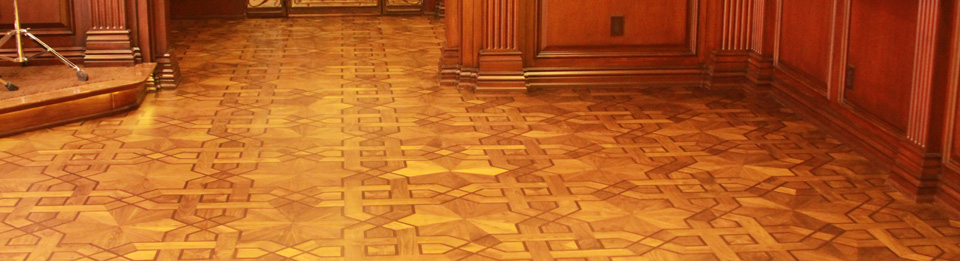
Reclaimed 19th Century Parquet Flooring
19th century parquet is a breakdown of old patterns of the European oak parquet designs. These 19th century parquet designs show the true art of marquetry with combined similarity parquetry. The 19th Century Parquet is a combination of two or more designs in one pattern to form an exquisite floor. The technique used in manufacturing and designing the 19th century parquet leaves nothing to be desired.
The Artistry of 19th Century European Parquet Design
The 19th century parquet tradition represents the pinnacle of European woodworking craftsmanship, where master artisans developed complex geometric patterns that combined multiple traditional designs into unified floor compositions. Unlike single-pattern installations such as Versailles or chevron, 19th century parquet integrates two or more classical patterns—often Versailles with Palace, or Louvre with Bordeaux—into sophisticated compositions that showcase both marquetry (decorative inlays using different wood species) and parquetry (geometric wood patterns). These patterns created floors that served as functional art pieces in grand estates, palaces, and formal buildings throughout Europe.
During the height of the European parquet movement in the 1800s, wealthy families commissioned custom floor designs that combined family crests, floral motifs, and geometric patterns into elaborate compositions requiring years to complete. Master parquet craftsmen trained for decades to develop the mathematical precision and artistic vision necessary to create these complex installations. The most celebrated examples still exist in French châteaux, Austrian palaces, and Italian villas, where tourists marvel at floors that have survived 150+ years of use while maintaining their geometric integrity and visual brilliance.
True reclaimed parquet flooring from the 19th century is increasingly rare and valuable. Original antique parquet panels salvaged from European buildings carry centuries of history and patina that cannot be replicated in new construction. We source these authentic antique woods from architectural salvage specialists who carefully remove parquet from buildings undergoing renovation or demolition. These materials are then restored and transformed into exquisite parquet flooring using traditional techniques that honor the original craftsmanship while adapting the materials for modern installation requirements and contemporary living standards.
Historical European Parquet Pattern Combinations
Classic 19th century pattern combinations followed established design principles developed over centuries of European parquet evolution. The most sophisticated installations featured a central medallion in Versailles or Palace pattern, surrounded by geometric borders in contrasting patterns, with corner elements in complementary designs. These multi-pattern compositions created visual hierarchy that guided movement through formal rooms and emphasized architectural focal points like fireplaces, crystal chandeliers, or ornate ceiling medallions. The floor design worked in concert with wall treatments, furniture placement, and decorative arts to create unified interior environments.
The European oak used in 19th century parquet came from old-growth forests that no longer exist. These ancient oaks produced exceptionally dense, stable wood with tight grain patterns ideal for the precision cutting required by complex parquet designs. French oak from the forests of Burgundy and Limousin was particularly prized for its pale color and minimal grain variation, providing a neutral canvas that allowed geometric patterns to dominate visually. Austrian oak offered slightly warmer tones with subtle ray fleck figure that added texture without competing with pattern complexity. Slavonian oak from Croatia provided exceptional hardness for high-traffic palace corridors while maintaining workability for detailed cutting.
Contrasting wood species played crucial roles in 19th century parquet design. Dark walnut created borders and accent elements that framed lighter oak fields. Pale maple provided bright highlights within darker compositions. Exotic imports like Brazilian rosewood, Cuban mahogany, and Indonesian teak appeared in the most luxurious installations, their rich colors and exotic origins signaling wealth and international connections. Some palace floors incorporated ebony, kingwood, and satinwood in elaborate marquetry elements depicting flowers, musical instruments, and classical architectural motifs integrated within the geometric parquet patterns.
The mathematical precision required for multi-pattern 19th century parquet exceeded even the demanding standards of single-pattern installations. When different geometric systems intersected—such as where a Versailles square panel met a Louvre diamond border—craftsmen had to calculate exact dimensions for custom transition pieces that maintained proper proportions in both pattern systems. This required advanced mathematical skills including geometry, trigonometry, and proportion calculation. The slightest error would compound across the pattern, making large sections visibly misaligned and requiring complete removal and replacement to correct.
Marquetry and Parquetry: Complementary Techniques
Parquetry refers specifically to geometric wood patterns created from pieces of the same thickness arranged in repeating designs. Traditional parquet patterns like chevron, herringbone, Versailles, and basketweave are pure parquetry—the visual interest comes entirely from grain direction changes and geometric arrangement rather than from thickness variation or pictorial elements. The 19th century elevated parquetry to its highest expression through complex multi-pattern compositions and micro-precise dimensional control.
Marquetry involves creating pictorial images or decorative patterns using thin veneers of contrasting woods assembled like a jigsaw puzzle. While parquetry emphasizes geometric abstraction, marquetry can depict realistic scenes, floral arrangements, architectural elements, or abstract decorative motifs. The 19th century saw marquetry reach extraordinary sophistication in furniture making, with artisans creating photorealistic scenes using dozens of different wood species to capture subtle color gradations and naturalistic detail.
The combination of marquetry and parquetry in 19th century flooring created the most elaborate and valuable installations. A geometric parquet field in Versailles pattern might be interrupted by marquetry medallions depicting the owner's coat of arms, classical urns overflowing with flowers, or pastoral landscape scenes. These pictorial elements were set into the geometric pattern like gemstones in a geometric metalwork setting. The technical challenge of integrating two different woodworking techniques—geometric parquetry requiring mathematical precision and artistic marquetry demanding realistic representation—made these floors the ultimate demonstration of master craftsman capability.
Modern interpretations of 19th century parquet rarely attempt the full complexity of historical originals due to prohibitive costs and scarcity of skilled artisans capable of executing marquetry at period-appropriate quality levels. Contemporary installations typically focus on sophisticated geometric pattern combinations without pictorial marquetry elements, creating floors that reference historical craftsmanship while remaining economically feasible for luxury residential projects. However, for clients restoring documented historic properties or commissioning museum-quality reproductions, specialist craftsmen can still create authentic multi-technique installations matching historical examples.
Wood Species Selection and Color Palettes
Reclaimed European oak forms the foundation of authentic 19th century parquet reproductions. The tight, straight grain of oak provides visual uniformity within geometric pattern elements, preventing grain figure from competing with pattern geometry for visual attention. Quarter-sawn oak, where growth rings run perpendicular to the face surface, was preferred for parquet because this orientation produces maximum dimensional stability and reveals beautiful medullary ray flecks that add subtle texture without disrupting pattern clarity. The neutral color palette of oak—ranging from pale straw to warm honey—accepts custom stains beautifully while also looking sophisticated in natural finishes.
The aging characteristics of antique reclaimed oak enhance rather than diminish its suitability for parquet. Wood that has seasoned for 100+ years achieves exceptional dimensional stability, with seasonal expansion and contraction minimized compared to recently harvested timber. The natural oxidation and patina development creates subtle color variations between boards that add character and authenticity to reproductions of historical patterns. Small checks, nail holes, and wear marks from previous uses contribute historical character without compromising structural integrity when properly prepared and installed.
American walnut and European walnut provide rich chocolate brown tones with purple undertones that create sophisticated contrast when combined with lighter oak. In 19th century installations, walnut typically appeared in borders framing oak fields, in geometric accent elements within complex patterns, or alternating with oak in checkerboard and basketweave configurations. The natural color variation within walnut—from pale sapwood through medium brown heartwood to dark chocolate—allowed craftsmen to create tonal gradations within single-species installations by carefully selecting and arranging individual pieces.
Maple and sycamore offered the lightest natural tones available to 19th century craftsmen, providing bright highlights in multi-species compositions. Hard maple's creamy white color and fine, uniform grain made it ideal for delicate geometric elements and decorative borders where high contrast against darker woods was desired. European sycamore, with its subtle luster and silky texture, appeared in the most refined palace installations where its understated elegance complemented rather than competed with complex pattern work. Both species accept bleaching treatments that can lighten them further for maximum contrast in contemporary monochromatic color schemes.
Custom color finishing allows authentic 19th century pattern reproductions to work within contemporary interior design palettes while maintaining period-appropriate pattern complexity. Grey-toned stains applied to oak create sophisticated neutral floors that reference historical craftsmanship while feeling thoroughly modern. Whitewashed finishes lighten traditional patterns for coastal and Scandinavian-influenced interiors. Rich espresso and ebony stains darken oak to near-black for dramatic high-contrast installations. The key is maintaining sufficient tonal contrast between pattern elements to keep the geometric design readable regardless of the overall color direction.
Manufacturing Techniques: Traditional vs. Modern
Traditional 19th century manufacturing required extraordinary skill and precision achieved through hand tools and specialized jigs. Artisans cut individual parquet pieces using hand saws guided by wooden templates carved to exact specifications. Each geometric element had to fit precisely with adjacent pieces to create seamless pattern transitions and maintain visual integrity across large floor areas. The slightest variation in cutting angles would compound across the pattern, making the entire floor appear distorted. This painstaking hand craftsmanship meant that completing a single formal room could require 6-12 months of work by a master artisan and his apprentices.
The combination of multiple patterns within a single composition presented unique technical challenges that tested even master craftsmen. Where different geometric systems intersected—such as where a square Versailles panel transitioned to a diamond Louvre border—custom transition pieces had to maintain proper proportions in both pattern systems simultaneously. This required advanced mathematical skills to calculate exact dimensions where pattern geometry changed. Mistakes in these critical transition zones could not be hidden or corrected without complete removal and replacement of surrounding pattern elements.
Modern CNC technology enables precision cutting of parquet elements to tolerances impossible to achieve with hand tools, while dramatically reducing material waste and production time. Computer-controlled routers can cut complex patterns from digital files with repeatability measured in thousandths of an inch, ensuring perfect fit between pieces and maintaining exact pattern specifications across entire production runs. This technology makes historically complex patterns economically feasible for contemporary luxury residential projects where hand-crafted pricing would be prohibitive for most clients.
However, machine precision cannot replace artisan judgment in wood selection, color matching, and quality assessment. Even with CNC cutting capabilities, creating museum-quality 19th century parquet reproductions requires experienced craftsmen who understand historical patterns, can select and arrange wood pieces to optimize color and grain, and possess the installation expertise to execute complex multi-pattern compositions flawlessly. The combination of modern technology for precision cutting with traditional artisan skills for design and installation produces the best results in contemporary parquet work.
Installation Methods and Technical Considerations
Glue-down installation is the only appropriate method for complex 19th century parquet patterns. The intricate geometric pieces and multi-pattern compositions require every element to be permanently bonded to a stable substrate to maintain precise alignment. Premium urethane or epoxy adhesives provide the bond strength necessary to hold precisely positioned pattern elements in permanent position throughout seasonal humidity variations and temperature fluctuations. Installation begins at the room's center with the primary pattern medallion, radiating outward symmetrically to maintain perfect visual balance and proportion.
The substrate preparation for museum-quality parquet must achieve exceptional flatness—typically within 1/16 inch over 10 feet, which exceeds standard flooring specifications. Because parquet pieces are relatively small compared to plank flooring, any substrate undulation will cause individual elements to rock or sit at different heights, disrupting the smooth surface required for the pattern to appear uniform and professionally executed. Self-leveling compounds are almost always necessary to achieve this level of substrate perfection, especially in older homes with settling foundations, uneven wood subfloors, or rough concrete slabs.
Moisture control is critical for long-term performance of complex parquet installations. The substrate moisture content must be tested and brought to appropriate levels (typically below 12% for wood subfloors, below 3% for concrete) before installation begins. Moisture barriers appropriate to the substrate type prevent ground moisture from migrating into the parquet and causing expansion that could buckle the precise pattern. The parquet materials themselves must be acclimated to the installation environment for minimum two weeks, reaching moisture equilibrium with the ambient conditions before cutting and installation begin.
Border and transition details require careful planning to integrate 19th century parquet patterns with room architecture and adjacent flooring materials. Traditional installations used complementary borders to frame the main pattern field, providing visual definition and solving the mathematical challenge of fitting geometric patterns into rectangular room dimensions. These borders also created natural transition points where parquet patterns met standard plank flooring in hallways and adjacent rooms. Modern installations may incorporate metal inlay strips, contrasting wood species borders, or simplified geometric transition elements that reference historical approaches while working within contemporary budgets.
Design Applications and Room Suitability
Grand entry foyers represent the ideal application for 19th century parquet flooring. The pattern complexity and craftsmanship create immediate impressions of quality and attention to detail that set expectations for the entire home. A central pattern medallion can serve as a visual focal point that organizes circulation patterns and draws attention to architectural features like sweeping staircases, crystal chandeliers, or double-height ceilings. The formality implied by complex parquet establishes the entry as a special transitional space between public exterior and private interior domains.
Formal dining rooms benefit from the sophisticated elegance of multi-pattern parquet flooring. The geometric precision complements traditional dining furniture and architectural details like crown molding, wainscoting, and coffered ceilings. When the dining table is removed for cleaning or reconfiguration, the parquet pattern becomes a decorative feature in its own right, revealing the full artistry of the installation. The pattern also helps define the dining zone within open-concept floor plans, creating visual boundaries without requiring walls or partitions that would interrupt sight lines.
Home libraries and private studies gain intellectual gravitas from 19th century parquet flooring. The pattern's association with European classical architecture evokes the libraries of historic universities, noble estates, and scholarly institutions, creating atmospheres conducive to reading, contemplation, and intellectual pursuits. The geometric order of complex patterns provides satisfying visual counterpoint to the organic randomness of book spines, leather bindings, and paper materials that dominate library spaces. Rich walnut and oak combinations create warm, enveloping environments appropriate for intimate, focused activities.
Historic restoration projects may require accurate reproduction of documented original parquet patterns to maintain architectural authenticity and preserve cultural heritage. Working from archival photographs, architectural drawings, measured surveys of surviving pattern sections, and historical building records, specialist craftsmen can recreate exact pattern specifications, wood species combinations, and installation details appropriate to the building's construction period. These reproductions become part of the property's historical fabric, contributing to its significance as a cultural resource and enhancing its value as an irreplaceable architectural artifact.
Maintenance and Long-Term Preservation
Daily maintenance of complex 19th century parquet requires soft-bristle brooms or microfiber dust mops that capture dirt and debris without scratching delicate finish coatings or abrading wood surfaces. The geometric pattern creates numerous joints and slight height variations where dust can accumulate, making regular cleaning more important than with simple plank floors. Weekly vacuuming with hardwood floor attachments (beater bars disabled) removes particles from pattern recesses and joints before they can embed in finish coatings or cause abrasive wear.
Humidity control between 35-55% relative humidity year-round is essential for preserving the tight fit and crisp geometry of complex parquet patterns. Wood expansion during humid summer months can create pressure within the pattern that stresses glue joints and may cause individual pieces to buckle or tent above the surrounding field. Contraction during dry winter heating season can open gaps between pattern elements, disrupting visual unity and allowing dirt to accumulate in joints. Whole-house humidification and dehumidification systems maintain stable conditions that minimize seasonal movement and preserve long-term pattern integrity.
The finish system for valuable antique parquet must provide durable protection while allowing the wood's natural character and color variations to remain visible. Oil-based polyurethane finishes develop warm amber tones over time that enhance the antique character of reclaimed wood while providing excellent abrasion resistance and moisture protection. Water-based polyurethanes maintain color clarity and offer low-VOC application with faster drying times, though they may require additional coats to achieve durability comparable to oil-based systems. The choice depends on aesthetic preferences and performance requirements for the specific installation.
Refinishing considerations make preventative maintenance particularly important for irreplaceable antique parquet. While floors can be sanded and refinished multiple times over their lifespan, the complex pattern geometry creates challenges for sanding operations. Inexperienced operators may round over sharp geometric edges, soften the crisp lines where different patterns meet, or create visible scratch patterns by sanding against grain direction. Professional refinishing by craftsmen experienced with antique parquet is essential to preserve the floor's architectural character and historical integrity throughout refinishing cycles.
Comparing 19th Century Parquet to Other Patterns
Unlike single-pattern Versailles flooring, which uses one repeating geometric motif across the entire floor, 19th century parquet combines multiple patterns into unified compositions that create visual hierarchy and architectural emphasis. Versailles installations are more straightforward to plan and install because the same panel configuration repeats throughout the space. Multi-pattern 19th century designs require complex custom planning to determine optimal pattern placement, transition details, and border integration. The added complexity makes 19th century parquet significantly more expensive but creates more sophisticated, architecturally integrated results.
Chevron parquet creates strong directional flow through continuous V-shaped diagonal lines, while 19th century pattern combinations typically emphasize centralized medallions with radiating symmetry. Chevron's geometric simplicity (repeating angled planks in a single pattern) makes it more affordable and faster to install than multi-pattern 19th century designs. However, chevron's uni-directional character works less effectively in rooms where multiple focal points or circulation patterns require visual organization. The 19th century approach of combining patterns creates more complex visual interest suitable for grand formal spaces.
Bordeaux parquet incorporates curved elements and floral motifs that soften the strictly geometric character of many 19th century pattern combinations. While both approaches can create museum-quality floors with exceptional craftsmanship, Bordeaux appeals more to romantic and traditional design sensibilities while geometric 19th century combinations work in both classical and contemporary settings. The curves in Bordeaux patterns also make them more challenging and expensive to produce than geometric designs, though the added cost may be justified by the pattern's unique character and visual sophistication.
Simple herringbone or basketweave patterns represent entry-level parquet suitable for traditional homes where budget constraints preclude complex multi-pattern installations. These single-pattern approaches offer some geometric interest and craftsmanship appeal at fraction of the cost of 19th century reproductions. However, the visual impact and architectural presence of simple patterns cannot match the sophisticated elegance of authentic multi-pattern compositions. The choice depends on project budgets, architectural context, and whether the floor will serve as a neutral background or as a primary design feature.
Color Options and Custom Finishes
Natural oak tones in honey and golden hues create warm, inviting floors that work with traditional and transitional interior styles. These mid-tone finishes show wood grain clearly while providing enough color to partially hide minor dirt and wear between cleanings. Natural finishes also offer the greatest flexibility for future refinishing—the floor can later be lightened with whitewash or pickling techniques, or darkened with stain application, allowing the parquet pattern to adapt to evolving design preferences without requiring complete replacement.
Grey-toned custom finishes have become increasingly popular for 19th century parquet in contemporary luxury interiors. Custom grey stains applied to reclaimed oak create sophisticated neutral backdrops that complement modern color palettes dominated by whites, greys, and black accents. The complex parquet patterns remain clearly visible even in monochromatic grey finishes because grain direction changes and slight height variations at pattern junctions create subtle tonal variations. Cooler grey tones work particularly well in urban lofts and contemporary homes where industrial-influenced aesthetics prevail.
Dark espresso and ebony finishes on 19th century parquet create dramatic, high-contrast interiors with undeniable luxury appeal. These deep tones emphasize pattern complexity by making each geometric element visually distinct through the interplay of light and shadow on angled surfaces and grain direction changes. Dark parquet floors pair beautifully with light walls and furnishings, creating bold visual anchors in minimal interiors. However, dark finishes show dust and fine scratches more readily than lighter tones, requiring more frequent maintenance to maintain pristine appearance.
Multi-tone pattern combinations using contrasting wood species or varied stain applications create maximum pattern visibility and dramatic visual impact. Classic combinations include natural oak alternating with walnut-stained oak, or whitewashed sections contrasting with medium brown tones. When using stains to create multi-tone effects from a single wood species, different tones can be applied to raw wood before final finishing, ensuring consistent expansion characteristics throughout the pattern while achieving the visual contrast of mixed-species installations. This approach avoids differential movement concerns between species with different hardness and density characteristics.
Pricing and Investment Considerations
Authentic reclaimed material costs for 19th century parquet range $65-$150 per square foot depending on pattern complexity, wood species, and condition of salvaged materials. Genuinely antique parquet panels with documented provenance from notable buildings command premium pricing, often exceeding $200 per square foot for exceptionally rare examples. Custom reproductions using reclaimed antique oak but fabricated in traditional patterns cost $75-$125 per square foot for materials. The significant investment reflects the rarity and historical value of authentic materials, complex pattern work combining multiple geometric designs, and substantial waste from cutting intricate shapes.
Installation labor adds $45-$75 per square foot for master craftsmen experienced in complex parquet installation and pattern layout. Multi-pattern 19th century designs require significantly more installation time than single-pattern floors due to custom transition elements, border integration, and the precision required to maintain proper alignment across pattern changes. Total project costs frequently reach $110-$225 per square foot installed for museum-quality 19th century parquet reproductions, positioning it among the most expensive hardwood flooring options available.
Return on investment for 19th century parquet is strongest in historically significant properties, luxury estates, and high-value urban residences where the flooring investment aligns proportionally with overall property value. In competitive luxury real estate markets, authentic period-appropriate parquet may be an expected feature that sophisticated buyers actively seek, making its presence essential for achieving premium pricing. Conversely, installing expensive parquet in a modest home risks over-improvement where the investment cannot be recovered upon resale. Professional appraisers and luxury real estate specialists can provide guidance on whether 19th century parquet represents appropriate value enhancement for specific properties.
Lifetime value calculations favor 19th century parquet when considering potential lifespan of 100+ years with proper maintenance and preservation. The per-year cost of ownership becomes remarkably reasonable when amortized across multiple generations of occupancy. Unlike carpet, vinyl, or laminate flooring requiring replacement every 10-20 years, authentic parquet is installed once and maintained indefinitely through periodic refinishing. This permanence makes it environmentally sustainable and economically sound for families planning multi-generational occupancy or properties intended to become heritage assets passing through estates to future generations.
Custom Design and Consultation Services
Pattern research and documentation services help clients identify appropriate historical patterns for restoration projects or new installations inspired by documented examples. Our design team maintains an extensive reference library of 19th century parquet patterns from European architectural publications, museum archives, and documented installations. We can research specific patterns from photographs you provide, identify the component geometric systems, and develop specifications for accurate reproductions. This service is particularly valuable for historic preservation projects where documentation of original materials supports grant applications and preservation easement qualifications.
Custom pattern development allows clients to commission unique variations on traditional 19th century patterns, incorporating specific geometric elements, family crests, or decorative motifs while maintaining the essential character and craftsmanship quality of historical designs. Our team creates detailed CAD drawings showing exactly how custom patterns will lay out in your specific room dimensions, including border specifications, pattern transitions, and integration with architectural features. Color renderings help visualize wood species combinations and finish options before any materials are ordered or work begins.
Material sourcing for authentic reclaimed antique oak requires patience and flexibility, as availability depends on European salvage operations and building renovation cycles. We maintain relationships with specialty suppliers who source reclaimed oak from France, Austria, Germany, and Eastern Europe, providing access to authentic period materials as they become available. For projects requiring specific quantities or quality levels, we can arrange custom sourcing from architectural salvage specialists who remove parquet from documented historic buildings, providing complete provenance documentation that adds historical value and authenticity to your installation.
Visit Our Los Angeles Showroom
Experience the extraordinary beauty and craftsmanship of 19th century parquet flooring in person at our Los Angeles showroom. View authentic antique parquet samples showcasing different European pattern combinations, wood species selections, and period finishes. Walk on installed parquet floors to appreciate the pattern complexity and quality craftsmanship that defines these museum-quality installations. Our parquet specialists provide detailed consultations, historical pattern research, custom design services, and comprehensive project planning.
Showroom Location:
9216 S. Vermont Ave
Los Angeles, CA 90044
Hours:
Monday - Friday: 8:00 AM - 5:00 PM
Saturday & Sunday: By Appointment
Contact:
Phone: (213) 792-5908
Email: info@legnohardwood.com
Call today to schedule your 19th century parquet consultation. We provide professional design services, historical pattern research, detailed project estimates, and connections to master craftsmen throughout the Los Angeles area capable of executing complex multi-pattern installations to museum-quality standards.
Explore Expanded Options
Browse additional 19th century parquet patterns, antique wood species, and custom geometric designs not shown on this page.
View Full Gallery →